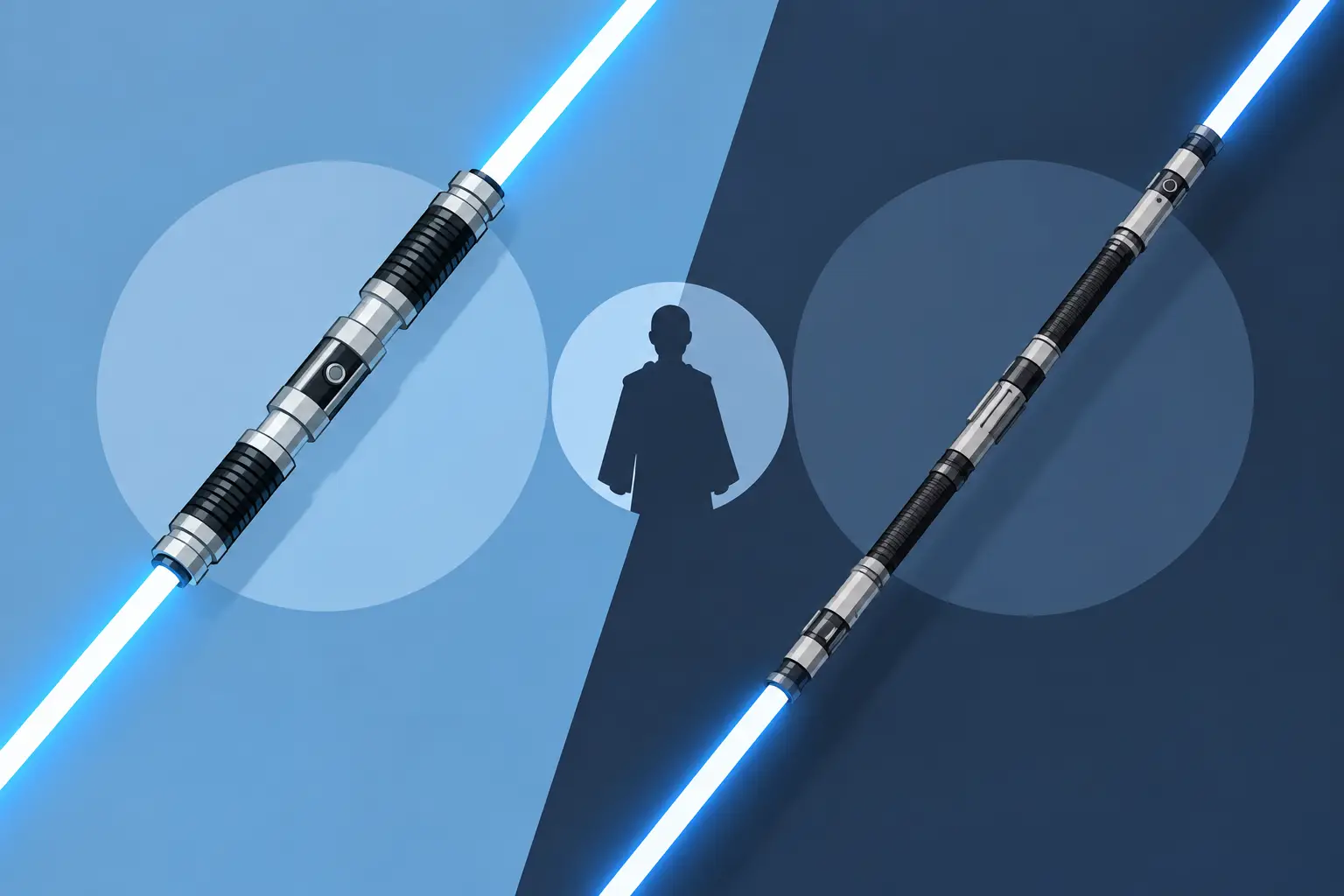
A double-bladed saber has instant presence. Before choosing one, though, the saber coupler versus staff hilt decision determines far more than the silhouette in your hand. One route joins two separate sabers into a staff. The other gives you one purpose-built hilt designed from the start for two blades. Both can look incredible, but they suit different fighting styles, collections, budgets, and cosplay plans.
For some fans, the right answer is flexibility: two sabers for two people, then one connected staff when the moment calls for it. For others, a dedicated staff hilt delivers the clean proportions and single-piece feel they want. Here is how to choose without ending up with a setup that looks right but feels wrong.
Saber Coupler Versus Staff Hilt: The Core Difference
A saber coupler is a connector that joins the pommel ends of two compatible lightsaber hilts. Once connected, those two single-blade sabers become a saberstaff. Disconnect them, and you are back to two independent sabers.
A staff hilt is one long, dedicated center hilt with an emitter at each end. It is built to accept two blades as a single double-bladed weapon. Depending on the model, it may use one control system, two independent electronics sets, or controls designed specifically for staff operation.
That difference changes the entire ownership experience. A coupler is an accessory-driven, modular approach. A staff hilt is a purpose-built approach. Neither is automatically better. The best choice comes down to whether versatility or a unified staff design matters more to you.
Choose a Saber Coupler for Flexibility
A coupler makes the most sense when you already own two compatible sabers or want your purchase to cover multiple uses. You can train with a single saber, hand one hilt to a friend, use matching hilts for a costume pair, or connect them for a double-bladed display piece.
This setup is especially appealing for families, couples, and fans building a collection over time. Two Padawan-friendly hilts can become a staff later, rather than forcing you to buy a separate weapon type on day one. It also gives you a backup: if one saber needs charging, blade maintenance, or service, you still have a complete saber available.
The trade-off is that compatibility matters. Couplers are not universal. The thread size, thread direction, pommel design, and available connection point all need to match. Some hilts need their pommels removed before the coupler can attach. Others are designed with a connector-ready base. Before ordering, confirm that the specific hilts and coupler are intended to work together.
A coupled setup can also place controls in less convenient positions. Since you are joining two full hilts, you may have two switches, two charging ports, and two sets of grip details near the center. That is not necessarily a problem, but it can affect hand placement during spins and transitions.
What a Coupler Does Well
A coupler excels when your saber needs to do more than one job. It is ideal for a fan who wants two single sabers for casual dueling but also wants a dramatic staff configuration for photos, conventions, or a Sith-inspired display.
It can be a smart value choice, too, if you would have purchased two sabers anyway. Instead of owning a single-use staff and then buying separate hilts later, you can build around components that stay useful in different configurations.
Just remember that a coupler does not magically make any two sabers duel-ready as a staff. The joined connection must be secure, both hilts should be designed for the intended level of use, and the total length needs to be manageable in your space.
Choose a Staff Hilt for a Purpose-Built Feel
A dedicated staff hilt is often the better choice for fans who know they want a double-bladed saber first and foremost. Its center section is designed for two-handed control, with a consistent grip profile and visual proportions that feel intentional from emitter to emitter.
For cosplay, this can make a major difference. A staff hilt generally has fewer visual interruptions at the center, no obvious connector piece, and a more screen-inspired or character-inspired profile. If the saber is going to spend as much time on a stand or at a convention as it does in your hands, that clean centerline is worth considering.
A purpose-built staff can also feel more predictable during controlled spinning practice. The balance is designed around staff use rather than created by combining the weight and geometry of two individual hilts. The center grip may be longer, smoother, or shaped to help your hands find their position without catching on pommel details or activation switches.
The limitation is simple: it is a staff. You cannot separate it into two full single-blade sabers when a friend wants to duel or when you want a different costume setup. Storage may also require more planning, since a staff hilt is longer even before blades are installed.
When the Dedicated Design Is Worth It
Choose a staff hilt when the double-bladed look is the point, not an occasional option. It suits the fan who wants an aggressive Sith presence, a non-Jedi character-inspired build, or a centerpiece that looks complete without extra hardware.
It is also a strong choice if you want a consistent center grip for choreography and non-contact spinning. A well-designed staff feels like one object, which can build confidence as you learn spacing, momentum, and hand transitions.
For full-contact-style recreational dueling, treat any double-bladed setup with extra respect. Staffs generate more leverage than a single saber, and both blades extend your striking zone. Use adequate space, protective gear appropriate to your activity, and controlled technique. A tougher configuration is not a substitute for safe training habits.
Handling, Length, and Balance Matter More Than You Think
The longest setup is not always the most fun setup. Two standard blade lengths on a staff can create an impressive look, but they may be awkward in a living room, crowded convention hallway, or beginner training session. Many fans prefer a slightly shorter blade configuration for better control.
With a coupler, the center section includes the rear ends of two hilts plus the connector. That can create a wider or more detailed central area. Some people love the substantial feel. Others find it harder to slide their hands during spins. A dedicated staff hilt usually offers a more consistent center grip, but specific designs still vary widely.
Weight deserves the same attention. Two complete electronic hilts connected together can be heavier than expected, especially with metal construction and batteries in both halves. That weight can make a coupled saber feel powerful for display and controlled strikes, yet tiring during long choreography sessions. A staff hilt may be lighter or heavier depending on its construction, so check the actual dimensions and weight instead of relying on photos.
Electronics and Blade Effects
A coupler setup usually means two independent sabers with independent batteries, soundboards, speakers, and controls. That is great for customization. You can set one blade red and one purple, use different sound fonts, or operate only one side when desired.
It also means twice the charging and settings management. If your sabers offer advanced effects, you may need to adjust each hilt separately. For collectors who enjoy customizing every detail, that is part of the fun. For someone buying a straightforward first staff, a dedicated hilt with simpler operation may feel less intimidating.
A staff hilt can have its own electronic arrangement. Some designs treat each side independently, while others are built around a unified control experience. Ask how activation, charging, volume, and blade settings work before choosing. A beautiful hilt is more enjoyable when its controls match the way you plan to use it.
A Quick Way to Make the Right Choice
Think about the saber's most common role. If you want two sabers that can occasionally become one, choose compatible hilts and a coupler. If you want a double-bladed weapon for display, cosplay, or dedicated staff practice, start with a staff hilt.
First-time buyers often benefit from the flexibility of two connected sabers, particularly if sharing and gifting are part of the plan. Experienced collectors may prefer the clean identity of a dedicated staff, especially when building a specific Jedi, Grey Jedi, or Sith loadout.
At SaberBros, the practical details matter as much as the fandom moment: checking component compatibility, selecting the right blade lengths, and choosing a setup that matches your comfort level. A personal inspection and real support can be especially reassuring when your build includes multiple parts.
Pick the configuration you will actually want to hold, display, and use. A coupler rewards the fan who likes options. A staff hilt rewards the fan who wants one unmistakable statement piece.